Skip to content


How DJI Zenmuse L3 LiDAR Detects Hidden Cliff Cracks Beneath Vegetation
- by Stefan Gandhi
In the UK professional drone sector precision mapping and environmental monitoring are critical for understanding complex terrain changes. One of the most challenging environments for geospatial teams is cliff stability assessment where dense vegetation blocks vital ground features. Traditional photogrammetry increasingly reaches its limits in such conditions.
This case study blog explores how the DJI Zenmuse L3 LiDAR payload is transforming the way geological instability and hidden cracks beneath vegetation are detected along unstable cliff faces. The following insights are drawn from real field applications, notably a project on the Asturian–Cantabrian Coast, where LiDAR mounted on drones reveals what photogrammetry alone cannot.
The Challenge Of Cliff Instability
Along the Jurassic cliffs of northern Spain, geological retreat is constant. These coastal formations are subject to complex mass movements including planar slides, block falls and material flows that affect tens of thousands of square metres of terrain. In these environments dense vegetation quickly grows over cracks and scarps, concealing signs of active geological displacement. In one prominent area near the Tazones lighthouse, a ground movement incident forced the evacuation of a restaurant after the appearance of hazardous cracks. Traditional ground survey methods such as total stations, manual drilling and visual inspection require time, resources and expose teams to risk when nearing unstable cliffs.
Adding to the complexity, dense trees and shrubs obscure ground features that are vital to understanding movement patterns. A crack that might herald an imminent collapse can be hidden beneath foliage, untreated in photogrammetric models because image-based systems struggle to see through leaf cover. This creates a critical demand for a technology that can penetrate vegetation and capture bare-earth data with high precision.
Enter The DJI Zenmuse L3 LiDAR System
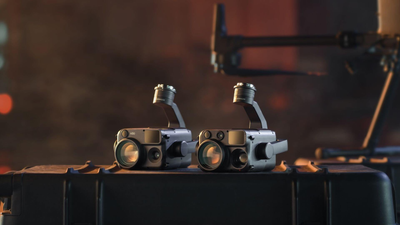
The DJI Zenmuse L3 is a next-generation aerial LiDAR sensor designed for professional mapping and geological applications. When mounted to a DJI Matrice 400 drone, it combines high-accuracy LiDAR with dual 100 megapixel RGB cameras to capture both spatial and visual data in one mission. It is engineered to deliver survey-grade results at scale with penetrative capability that sees through vegetation to expose the hidden ground surface.
LiDAR stands for Light Detection And Ranging. It emits rapid pulses of laser light toward the ground and measures the precise time taken for them to reflect back. The key for cliff monitoring is that LiDAR can record multiple reflections from a single pulse, known as 'returns'. This lets it log data points from the canopy, understorey and finally the ground surface. The Zenmuse L3 supports up to 16 returns per pulse, making it exceptionally effective in dense vegetation.
Coupled with LiDAR is the dual RGB camera system that captures ultra-high resolution imagery across a wide 107° field of view, which enhances the texture and colour of terrain models. Both LiDAR and visual data sync in post-processing pipelines to produce detailed 3D models with colourised point clouds that help analysts and engineers interpret terrain features easily.
LiDAR Versus Photogrammetry
Photogrammetry, the art of reconstructing 3D surfaces from overlapping photographs, is a powerful tool for many survey tasks. However, when vegetation blankets the ground it is blind to what lies beneath. When applied to cliff monitoring in vegetated zones, photogrammetric models often miss critical subsurface features like fissures and hidden scarps.
By contrast, the Zenmuse L3 LiDAR penetrates foliage layers and captures the true bare-earth topography. The capability to collect up to 2 million data points per second with multiple returns allows operators to build high-density point clouds that expose subtle ground deformations, fault lines and progressive crack networks previously hidden from view. These point clouds form the backbone of precise 3D terrain models that inform geological risk assessments and long-term stability studies.
Field Application On The Asturian Coast
In the coastal cliff case study, researchers mounted the Zenmuse L3 on a Matrice 400 drone system and conducted systematic LiDAR surveys across unstable slopes. The area of interest has a known history of movement with displacements of up to 14 metres observed in a single night. Vegetation was so dense in some sections that even known cracks were hidden from sight.
With L3 LiDAR, the team could scan over and under vegetation to extract the bare-earth surface. The resulting point cloud revealed previously undetected cracks and scarps with millimetre-level accuracy. Engineers then overlaid LiDAR outputs with visual imagery to verify interpretations and prioritise areas for further ground investigation.
This LiDAR approach significantly reduced the time spent on site while vastly improving safety. Instead of sending field teams to hazardous cliff edges with hand tools and physical measuring equipment, operators could survey from the air and make decisions based on clear quantitative data.
Creating High Precision 3D Terrain Models
Once LiDAR data is captured, it is processed through software to generate comprehensive 3D terrain models. The value of these models for professional users cannot be overstated. They allow geospatial technicians, engineers and environmental specialists to:
- Visualise cliff geometry in three dimensions
- Detect emerging cracks and scarps beneath vegetation
- Quantify displacement and model future movement scenarios
- Support land use planning and hazard mitigation strategies
- Produce shareable maps and reports for stakeholders
The combination of LiDAR penetration capability and high-resolution imagery delivers actionable insights that would be nearly impossible with photogrammetry alone in vegetated terrain.
Benefits For UK Drone Professionals
For UK organisations involved in surveying, civil engineering, mining or environmental monitoring, the Zenmuse L3 is a compelling tool for tackling terrain challenges. Its ability to capture accurate elevation data beneath vegetation makes it ideal for:
- Coastal and cliff stability assessments
- Forestry and biomass studies
- Linear infrastructure surveys (railways, pipelines)
- Habitat mapping and conservation planning
- Utility corridor inspection and clearance planning
In the UK, where steep slopes and vegetated landscapes are common, the L3’s performance in penetrating vegetation cover enables more reliable terrain analysis than photogrammetry alone. Its high precision and efficiency help reduce operational costs and field time while improving safety and data quality.
FAQs
What is DJI Zenmuse L3 designed for?
The DJI Zenmuse L3 is an aerial LiDAR payload that captures dense, high-accuracy point clouds and high-resolution imagery simultaneously. It is optimised for professional mapping, topographic surveys, and terrain modelling including under vegetated conditions.
How does LiDAR penetrate vegetation?
LiDAR emits laser pulses that can reflect multiple times within a canopy. These multiple returns allow the sensor to capture points from leaves, branches and finally the ground surface, making it possible to reconstruct bare-earth models even under dense vegetation.
What drone is compatible with Zenmuse L3?
The Zenmuse L3 is compatible with the DJI Matrice 400 series using a dedicated gimbal connector.
What data outputs can I expect?
Operators can generate point clouds, digital elevation models (DEM), digital surface models (DSM) and colourised 3D models. RGB imagery captured alongside LiDAR enhances visual interpretation.
Is LiDAR data better than photogrammetry for vegetation?
For vegetated terrain where ground features are obscured, LiDAR is superior because it can detect beneath the canopy and produce an accurate bare-earth model, while photogrammetry relies on visible surface features.
Conclusion
The DJI Zenmuse L3 LiDAR payload is redefining what is possible in professional drone surveying. Its ability to penetrate dense vegetation and reveal hidden cliff cracks beneath foliage makes it indispensable for geological monitoring and hazard assessment applications. By generating high-density point clouds and precise 3D terrain models, the L3 empowers UK drone professionals to make informed decisions backed by robust spatial data. For teams committed to advancing their surveying capabilities, the Zenmuse L3 delivers precision, efficiency, safety and confidence.