Skip to content


DJI Matrice 4 Enterprise vs Mavic 3 Enterprise: Is It Worth the Upgrade?
- by Lana De Souza
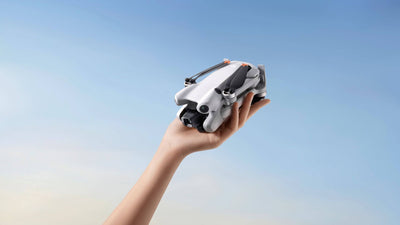
The DJI Mavic 3 Enterprise (M3E) set a strong benchmark for compact commercial drones. With a 4/3 CMOS wide camera, mechanical shutter, and an optional RTK module, it became a go-to platform for mapping, inspection, and survey teams. The DJI Matrice 4 Enterprise (M4E) is its successor, and it raises the bar in several areas that matter most to professional operators. Here is how the two platforms compare, based entirely on official DJI specifications.
Flight Performance
The M4E reaches 21 m/s in normal flight mode. The M3E tops out at 15 m/s in normal mode, reaching up to 21 m/s forward only in sport mode. For survey and inspection work conducted in normal mode, the M4E's speed advantage means more ground covered per battery. Maximum flight time increases from 45 minutes on the M3E to 49 minutes on the M4E, and maximum flight distance improves from 32 km to 35 km. The M4E weighs more at 1,219 g with standard propellers (1,229 g with low-noise propellers) compared to the M3E's 915 g, but both sit well below the 2 kg regulatory threshold relevant to UK operators under CAA rules.
Camera System: Three Lenses vs Two
The M3E carries two cameras: a 4/3 CMOS 20 MP wide camera with both a mechanical shutter (8-1/2000s) and electronic shutter (8-1/8000s), and a minimum photo interval of 0.7 seconds. The second camera is a 1/2-inch CMOS 12 MP telephoto at 162 mm equivalent focal length, f/4.4 aperture, delivering 56x hybrid zoom. It is a capable setup that has served mapping and inspection teams well.
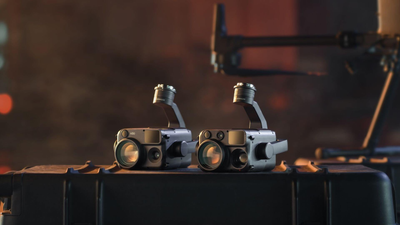
The M4E carries three cameras. The wide is a 4/3-inch CMOS 20 MP sensor with an 84-degree FOV, 24 mm equivalent focal length, f/2.8-f/11 aperture, mechanical shutter, and a minimum photo interval of 0.5 seconds. The medium telephoto is a 1/1.3-inch CMOS 48 MP sensor with a 35-degree FOV, 70 mm equivalent focal length, and f/2.8 aperture. The telephoto is a 1/1.5-inch CMOS 48 MP sensor with a 15-degree FOV, 168 mm equivalent focal length, f/2.8 aperture, and 112x hybrid zoom, double the reach of the M3E. For mapping teams, the faster interval reduces survey time on large sites. For inspection operators, the extended zoom and higher-resolution telephoto provide significantly more detail at distance.
Laser Rangefinder
The M4E is the first DJI enterprise drone under 2 kg to include a built-in laser rangefinder, with a measurement range of 1,800 metres at 20% target reflectivity and a blind zone of just 1 metre. The M3E has no equivalent capability. For inspection teams working from a safe standoff distance on powerlines, structures, or rooftops, this adds a layer of situational awareness that previously required a separate payload.
RTK: Built In vs Add-On
On the M3E, RTK is a separate 24-gram module that connects via USB-C and must be purchased separately. On the M4E, RTK is integrated as standard. Both platforms deliver the same positioning accuracy: 1 cm + 1 ppm horizontal and 1.5 cm + 1 ppm vertical. The M4E connects directly to NTRIP CORS networks and supports the DJI D-RTK 3 Multifunctional Station.
Having RTK built in removes a step from setup, eliminates a potential point of failure, and changes the price comparison. When both platforms are configured with RTK, the M4E becomes considerably more competitive, while also offering the additional cameras, rangefinder, and improved transmission.
Transmission and Controller
The M3E uses DJI O3 Enterprise transmission with four antennas, a maximum CE-regulated range of 8 km, a download speed of 15 MB/s, and a latency of approximately 200 ms. The M4E upgrades to DJI O4 Enterprise with eight antennas, a maximum CE range of 12 km, a download speed of 20 MB/s, and a latency of 130 ms. For UK operators, the step from 8 km to 12 km CE range is a meaningful operational gain on long corridor surveys and beyond visual line of sight flights.
The RC Plus 2 controller supplied with the M4E is also a step up from the M3E's RC Pro Enterprise: a 7.02-inch 1,400-nit screen versus a 5.5-inch 1,000-nit display. The larger, brighter screen makes a noticeable difference in bright outdoor conditions.
AI Detection and Accessories
The M4E includes built-in AI detection for vehicles, vessels, and people, with support for custom models via the DJI AI Developer Platform. The M3E has no equivalent. The M4E's optional AS1 Speaker delivers 114 dB at 1 metre with a 300-metre effective broadcast range, compared to 110 dB and a 100-metre effective range on the M3E's optional speaker. For public safety and search and rescue teams, that difference in broadcast range is operationally significant.
Is It Worth the Upgrade?
For existing M3E users running standard orthomosaic mapping with RTK already in place, the jump in 2D output quality is modest. Both wide cameras use the same 4/3 CMOS 20 MP sensor. The M4E's faster interval and higher cruising speed will reduce flight time per survey, but the difference in orthomosaic output is not dramatic. The upgrade case strengthens if your work involves inspection, where the extended zoom, medium telephoto, and laser rangefinder add direct value; if the 12 km CE range addresses a real operational need; or if AI detection and the improved speaker range matter to your missions.
For anyone buying new, the M4E is the clear choice. At a comparable RTK-equipped price point it delivers a three-camera array, a laser rangefinder, O4 Enterprise transmission, AI detection, and a substantially better controller. There is no compelling reason to choose the M3E as a new purchase.
FAQs
What is the DJI Matrice 4 Enterprise?
The DJI Matrice 4 Enterprise is a compact professional drone released in early 2025. At 1,219 g with standard propellers, it carries three cameras, built-in RTK, a laser rangefinder, and DJI O4 Enterprise transmission with a 12 km CE-regulated range.
How does the Matrice 4 Enterprise differ from the Mavic 3 Enterprise?
The M4E adds a third medium telephoto camera (1/1.3-inch CMOS, 48 MP, 70 mm), upgrades the telephoto to 48 MP with 112x hybrid zoom, includes RTK as standard rather than an optional add-on, adds a built-in laser rangefinder (1,800 m at 20% reflectivity), upgrades transmission to O4 Enterprise (12 km CE vs 8 km CE), and adds AI object detection. It is also faster in normal mode at 21 m/s versus the M3E's 15 m/s.
What is the transmission range of the Matrice 4 Enterprise in the UK?
Under CE regulations, the M4E achieves a maximum transmission range of 12 km on O4 Enterprise. The Mavic 3 Enterprise reaches 8 km under the same CE standard on O3 Enterprise.
Does the DJI Matrice 4 Enterprise include RTK?
Yes. RTK is built in as standard with 1 cm + 1 ppm horizontal and 1.5 cm + 1 ppm vertical accuracy. On the Mavic 3 Enterprise, RTK is a separate optional module.
Is the DJI Matrice 4 Enterprise under 2 kg?
Yes. At 1,219 g with standard propellers it sits below the 2 kg threshold, which is relevant for UK operators under CAA regulations.
What cameras does the DJI Matrice 4 Enterprise have?
Three: a 4/3-inch CMOS 20 MP wide with mechanical shutter and 0.5-second minimum interval, a 1/1.3-inch CMOS 48 MP medium telephoto at 70 mm (f/2.8), and a 1/1.5-inch CMOS 48 MP telephoto at 168 mm (f/2.8) with 112x hybrid zoom. The Mavic 3 Enterprise carries a 4/3 CMOS 20 MP wide and a 1/2-inch CMOS 12 MP telephoto at 162 mm with 56x hybrid zoom.
Final Thoughts
The DJI Matrice 4 Enterprise is a genuine step forward from the Mavic 3 Enterprise. Three cameras, built-in RTK, a 1,800-metre laser rangefinder, O4 Enterprise transmission at 12 km CE range, AI detection, and an upgraded controller together make a compelling package. Current M3E users with a solid mapping setup do not need to upgrade today unless specific M4E capabilities address a gap in their operations. For anyone buying new or stepping up from an older platform, the M4E is the right starting point.
Ready to add the DJI Matrice 4 Enterprise to your fleet? Explore the full range at Coptrz, the UK's leading enterprise drone specialists.