Skip to content


DJI Avata 360 vs DJI Avata 2: Key Differences Explained
- by Stefan Gandhi
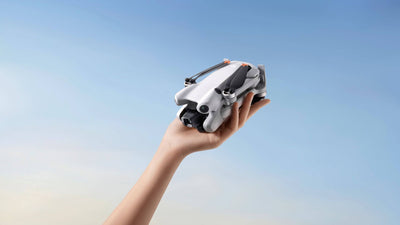
DJI's Avata series has become the go-to choice for pilots who want immersive FPV flight without the complexity of traditional DIY builds. Agility, cinewhoop-style footage, and full-coverage propeller guards have made the Avata family a firm favourite, and now DJI has added a new member to the lineup.
The DJI Avata 360 is a hybrid 360° and FPV drone, while the DJI Avata 2 is a dedicated single-lens FPV flyer. They share a family name, but they serve different creative needs. So which one is right for you? Here's an in-depth look at the key differences.
Camera: Two Lenses vs One
This is the biggest distinction between the two drones. The Avata 360 features two 1/1.1-inch square CMOS sensors, each with 64 megapixels of effective resolution and a 200° field of view. Together, they capture full 360° video at up to 8K/60fps HDR and 120MP stills, giving you enormous flexibility to reframe shots in post-production, adjusting angles, adding camera movements, and pulling multiple perspectives from a single flight.
The Avata 2 uses a single 1/1.3-inch image sensor with 12MP effective pixels and a 155° field of view. It shoots up to 4K/60fps (or 4K/100fps in slow motion), producing classic FPV footage with excellent quality. The trade-off is that your framing is locked in at the time of recording.
Crucially, the Avata 360's camera module rotates, letting you switch between 360° mode and a Single Lens mode that shoots standard forward-facing 4K/60fps video. So you're effectively getting two drones in one. The Avata 2 is confined to its single lens.
It's also worth noting that the Avata 360 supports both JPEG and DNG photo formats with a higher max video bitrate of 180 Mbps, compared to the Avata 2's 130 Mbps and JPEG-only photos. However, the Avata 360 does not support ND filters, whereas the Avata 2 does, which is something to consider depending on your shooting style.
Flight Performance
Both drones are agile flyers, but they differ in speed and flight modes. The Avata 360 is slightly quicker in Normal mode (16 m/s vs 8 m/s) and Sport mode (18 m/s vs 16 m/s). However, the Avata 2 has a Manual mode that pushes up to 27 m/s, a feature the Avata 360 lacks entirely. If raw speed and full manual control matter to you, that's a point in the Avata 2's favour.
Both drones support Acro mode for acrobatic manoeuvres using the RC Motion 3, and it's worth noting that acrobatic-style footage can also be created in post-production with the Avata 360's 360° footage.
The Avata 360 also offers more advanced tracking features in 360° mode, including FocusTrack, ActiveTrack 360°, Spotlight Free, and Head Tracking when paired with goggles and a motion controller. The Avata 2 has more limited tracking, offering Head Tracking when used with DJI Goggles.
Flight time is essentially identical. Both are rated at 23 minutes, with hovering times of 22 and 21 minutes respectively.
Obstacle Avoidance: A Major Upgrade
This is where the Avata 360 takes a significant step forward. It features an omnidirectional vision system supplemented by forward-facing LiDAR and a 3D infrared sensing system. This provides full 360° obstacle avoidance in 360° mode, and forward obstacle sensing in Single Lens mode.
The Avata 2 has no obstacle avoidance at all, only downward and backward visual positioning. If you're flying close to structures, which is often the entire point of FPV, the Avata 360's sensing system provides a much larger safety net. The LiDAR also enables better detection in lower-light environments, with the Avata 360 operating in conditions as low as 1 lux compared to the Avata 2's 15 lux requirement.
Video Transmission
The Avata 360 runs on DJI's O4+ transmission system, while the Avata 2 uses O4. In FCC regions, this extends the Avata 360's range to 20km versus the Avata 2's 13km. In CE regions such as the UK, both are capped at 10km, though the enhanced O4+ system may still offer improved signal stability.
Live view quality is comparable, with both delivering 1080p feeds. The Avata 360 also benefits from Wi-Fi 6 downloads at up to 100 MB/s, compared to the Avata 2's 30 MB/s over standard Wi-Fi.
Class Marking and Regulations
For UK pilots, this is an important consideration. The Avata 360 carries a UK1 class mark (as well as a C1 mark), while the Avata 2 only has a C1 class marking. Currently, both can fly in the A1 subcategory without requiring an A2 CofC. However, from 2028, non-UK-class-marked drones like the Avata 2 will become "legacy," restricting them to the A2 or A3 subcategories. The Avata 360's UK1 marking means it can continue flying in the A1 subcategory indefinitely, a real advantage for long-term use.
Control Methods
The Avata 360 offers more flexibility here. It can be used as a standard drone with the RC 2, RC-N3, or RC-N2 without needing goggles, or flown as a full FPV aircraft with DJI Goggles 3 or Goggles N3 paired with the RC Motion 3 or FPV Remote Controller 3.
The Avata 2 is very much an FPV drone and requires goggles for use. It's compatible with DJI Goggles 3, Goggles N3, Goggles Integra, and Goggles 2, along with the RC Motion 3, RC Motion 2, and FPV Remote Controllers.
Price
The DJI Avata 360 ranges from £635 to £829 depending on the combo, whilst the DJI Avata 2 ranges from £539 to £889. Entry cost is lower on the Avata 2, but the Avata 360 delivers considerably more capability for the price difference.
Which Avata Drone Is Best for You?
It comes down to what you want from your flying experience. If you want creative, immersive 360° video with the flexibility to switch between 360° and Single Lens modes, plus the added safety of obstacle avoidance and future-proof UK class marking, the Avata 360 is the drone to go for.
If you prefer a streamlined, traditional FPV workflow with smooth cinematic footage, full manual control, and a lower entry price, the Avata 2 remains an excellent choice.
Shop now for the DJI Avata 360 from the Coptrz official online store.