Skip to content


DJI Avata 360 vs Antigravity A1: Which 360 Drone Should You Choose?
- by Stefan Gandhi
The DJI Avata 360 and the Antigravity A1 are the two most capable 360° drones on the market, and they target very different pilots. The Avata 360 delivers larger sensors, higher frame rates, built-in prop guards, a deeper controller ecosystem, and a more attractive price tag, while the Antigravity A1 doubles down on portability with a foldable sub-250g frame and an immersive goggles-only flight experience. This in-depth comparison shows which platform suits your budget, shooting style and workflow.
Key Takeaways
- The DJI Avata 360 can switch between 360° mode and Single Lens mode, while the Antigravity A1 is a dedicated 360° drone.
- Avata 360 offers a broader ecosystem and can be flown with a standard controller, FPV controller, Motion Controller, or goggles. Antigravity A1 requires goggles and a Motion Controller.
- Avata 360 uses two 1/1.1-inch square CMOS sensors, whereas Antigravity A1 has smaller 1/1.28-inch sensors.
- Both drones shoot 8K video. Avata 360 hits 8K at 60fps, Antigravity A1 tops out at 8K at 30fps.
- Antigravity A1 weighs under 250g with its standard battery and folds for easier transport. Avata 360 weighs 455g and does not fold.
- Antigravity A1 flies for 24 minutes on the Flight Battery, or 39 minutes with the High-Capacity Flight Battery (which pushes weight to 291g). Avata 360 flies for 23 minutes.
- Avata 360 ships with built-in prop guards, an omnidirectional vision system, and forward-facing LiDAR. Antigravity A1 has forward and downward vision plus infrared, with prop guards sold separately or included in specific bundles.
- Avata 360 is significantly cheaper than Antigravity A1. Prices sit between £635 and £829 for the Avata 360, while the cheapest Antigravity A1 bundle costs more than £1,000.
360 Drones Enter The Mainstream
The battle of the 360° drones has properly begun. The Antigravity A1 arrived in the latter stages of 2025, heralded as the world's first 8K all-in-one 360° drone. In March 2026, DJI responded with the Avata 360, its own 8K 360° platform built on the Avata lineage.
A previously niche category now has two polished, mainstream-ready contenders. The Avata 360 and the Antigravity A1 are fighting for the same creators, which makes the choice between them worth getting right.
Design Differences Between The DJI Avata 360 & Antigravity A1
shop.coptrz.com | The Drone Pilot's Journal Page 1Both platforms are 360° drones, but they take different design routes. The DJI Avata 360 is fitted with full-coverage propeller guards, whereas the Antigravity A1 flies with exposed propellers unless you buy or bundle the optional guards.
Those guards are part of why the Avata 360 tips the scales at 455g, while the Antigravity A1 comes in under 250g with its standard battery, rising to 291g with the High-Capacity Battery. That keeps the Avata 360 in EU-C1 and UK1 territory, while the Antigravity A1 sits at EU-C0 with the Standard Flight Battery or EU-C1 with the High-Capacity Battery.
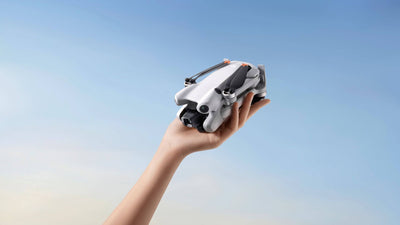
The Avata 360 has a fixed frame. The Antigravity A1 folds. Combined with its smaller footprint, the A1 is clearly the more travel-friendly option if pack size is a priority.
Both drones carry two 360° cameras, one facing up and one facing down. The Avata 360 also has a rotating gimbal, letting it behave like a conventional single-lens craft when needed. Both support microSD cards up to 1TB, with internal storage of 42GB on the Avata 360 and 20GB on the Antigravity A1.
DJI Avata 360 Vs Antigravity A1 Camera Performance
Both drones shoot 8K, but the Avata 360 leads on sensor size, aperture, frame rate, and creative flexibility.
Sensors & Image Quality
The Avata 360 uses two 1/1.1-inch square CMOS sensors, each delivering panoramic coverage equivalent to a 1-inch sensor. The Antigravity A1 uses smaller 1/1.28-inch sensors. The Avata's larger sensors and wider f/1.9 aperture (against the A1's f/2.2) pull in more light, which means cleaner footage, better low-light performance, and more usable dynamic range.
The Avata 360 also supports D-Log M for a flat, gradable colour profile. The Antigravity A1 does not, which limits post-production control over colour, contrast, and style.
Video & Photos
The Avata 360 captures 8K at 60fps with a maximum video bitrate of 180 Mbps. The Antigravity A1 tops out at 8K at 30fps with a 170 Mbps bitrate. In Single Lens mode, the Avata 360 shoots 4K at 60fps.
For stills, the Avata 360 delivers 30MP or 120MP 360° photos, compared to 14MP or 55MP on the Antigravity A1. The Avata 360's Single Lens mode does not capture stills.
Flight Performance & Control
Control Options
The DJI Avata 360 can be flown FPV with goggles and either the DJI RC Motion 3 or the DJI FPV Remote Controller 3, or as a standard drone with the DJI RC 2, DJI RC-N2, or DJI RC-N3. The Antigravity A1 flies exclusively with its Vision Goggles and grip Motion Controller. The Avata 360 can also be flown backwards, which the A1 cannot.
Flight Time & Speed
The Antigravity A1 edges the Avata 360 on flight time, with 24 minutes on the Flight Battery against 23 minutes on the Avata 360. Fit the High-Capacity Flight Battery and the A1 stretches to 39 minutes, though it crosses the 250g threshold at 291g. On speed, the Avata 360 is slightly quicker in Sport mode, with 18 m/s against 16 m/s. Neither drone flies in Manual mode.
Video Transmission & Smart Features
The Avata 360 runs DJI's O4+ system, with 1080p at 60fps live view, up to 20km range (FCC), and around 130ms latency. The Antigravity A1 uses OmniLink 360 for 2K at 30fps live view, up to 10km range (FCC), and roughly 150ms latency. For tracking, the Avata 360 has ActiveTrack 360° (Standard and Cycling) plus FPV gimbal mode. The A1 counters with Deep Tracking, where subject and framing can be adjusted in post without quality loss.
Flight Safety & Obstacle Avoidance
Flight safety matters, and while both drones are solid, the Avata 360 has the more comprehensive package. The Avata 360 pairs an omnidirectional vision system (forward-only in Single Lens mode) with a bottom infrared sensor and forward-facing LiDAR, letting it detect obstacles in conditions as low as lux > 1. The A1 relies on forward and downward vision sensors plus infrared and needs lux > 15 to work reliably.
Built-in prop guards on the Avata 360 add further protection from the moment you unbox it. Both drones support lens replacement kits for scratched optics, which is a welcome long-term touch.
Product Ecosystem & Available Bundles
The Avata 360 taps into DJI's wider ecosystem. Pilots already invested in DJI Goggles 3, Goggles N3, RC Motion 3, the FPV Remote Controller 3, or the RC 2 can often fly the Avata 360 without buying a full new kit. The Antigravity A1 sits inside a new, self-contained ecosystem built around its Vision Goggles and grip controller. The Vision Goggles do have genuinely clever touches, including an external display for spectators, Micro-OLED screens for crisp viewing, and Head Tracking across the range.
The Avata 360 is sold as the DJI Avata 360 with RC 2, the DJI Avata RC 2 Fly More Combo, and the DJI Avata 360 Motion Fly More Combo. The Antigravity A1 ships in Standard, Explorer, and Infinity bundles.
Price Comparison
Price is where the gap becomes hard to ignore. At launch on 26 March 2026, the Avata 360 sits between £635 and £829 depending on the bundle. The cheapest Antigravity A1 bundle costs more than £1,000. The Avata 360 is also the better-specced platform on camera and safety, which makes the pricing picture even more favourable for DJI's option.
FAQs
Is the DJI Avata 360 better than the Antigravity A1?
The DJI Avata 360 beats the Antigravity A1 on sensor size, aperture, 8K frame rate, video transmission, obstacle avoidance, and price. The Antigravity A1 wins on portability, with a sub-250g folding frame and a longer maximum flight time on the High-Capacity Battery.
Can you fly the Antigravity A1 without goggles?
No. The Antigravity A1 is designed as a fully immersive FPV 360° drone and only flies with its Vision Goggles and grip Motion Controller. If you want the option to fly without goggles, the DJI Avata 360 supports standard controllers and screen-based flight.
Does the DJI Avata 360 have obstacle avoidance?
Yes. In 360° mode the Avata 360 offers an omnidirectional vision system, a bottom infrared sensor, and forward-facing LiDAR. In Single Lens mode, only forward obstacle sensing is active.
How long does the Antigravity A1 fly for on one battery?
The Antigravity A1 flies for up to 24 minutes on the standard Flight Battery, or up to 39 minutes with the High-Capacity Flight Battery. Fitting the High-Capacity Battery pushes takeoff weight to 291g, so the drone loses its sub-250g class mark.
Is the Antigravity A1 foldable?
Yes. The Antigravity A1 has foldable arms and a smaller footprint than the Avata 360, which makes it the more travel-friendly 360° drone. The Avata 360 has a fixed frame and does not fold.
Conclusion
The DJI Avata 360 is the stronger all-round 360° drone on specs, safety, and price, making it the sensible pick for most creators and operators. The Antigravity A1 is the right call for pilots who prize portability and want a fully immersive goggles-only 360° FPV experience, especially where sub-250g flight is a regulatory advantage.
Browse the latest DJI Avata 360 and Antigravity A1 bundles, plus the full range of 360° drones and accessories, at the Coptrz official online store.