Skip to content


What Games Can Kids Play With Drones?
- by Stefan Gandhi
Drones are one of the most engaging toys a child can own, and the right games turn a quick flight in the garden into hours of skill building fun. This guide rounds up the best drone games for kids, covers the safety basics every parent should know, and explains how UK rules apply to younger pilots. You will also find tips on choosing a first drone that stands up to plenty of crashes and learning.
Are Drone Games Good For Kids
Drone games do far more than burn off energy on a rainy afternoon. Flying a drone develops hand to eye coordination, spatial awareness and patience, and many models double as a gentle introduction to coding and STEM. Programmable drones let children plan flight paths using drag and drop blocks before moving on to languages such as Python, so a game can quietly become a first lesson in robotics.
Confidence grows quickly too. A child who learns to take off, hover and land cleanly soon wants to try races, tricks and challenges with friends. Setting simple goals keeps that motivation high and gives every flight a sense of purpose.
Setting Up A Safe Space To Play
A little preparation makes drone games safer and more enjoyable. Always launch from a flat surface, keep well clear of roads and power lines, and choose an open area away from crowds. Indoors, clear breakable objects and give the drone plenty of room to manoeuvre.
UK rules are straightforward for young flyers. A child under 12 can fly outdoors when supervised by someone aged 16 or over, while 13 to 17 year olds can pass the free Flyer ID test and fly on their own. If a drone only ever flies indoors, or weighs under 100 grams, no Flyer ID or Operator ID is required, which makes lightweight toy models ideal for first attempts.
The Best Drone Games Kids Can Play
The games below work with almost any beginner drone and scale nicely as skills improve.
- Drone races. Mark a start line and a finish line, then time each pilot or fly head to head. For a fun twist, race the drone against a child running on foot.
- Obstacle courses. Use hula hoops, garden canes, cardboard boxes or trees to build a course, then challenge pilots to fly through without touching anything.
- Landing challenges. Draw target circles on paper or use floor tiles as landing pads. On the count of three everyone takes off, and the first to land neatly inside their zone wins.
- Aerial treasure hunt. Hide objects around the garden and give clues that can only be solved by spotting them from the air using a camera drone.
- Drone hide and seek. One pilot uses the drone to find friends hiding in spots that are tucked away but still visible from above.
- Statues from the air. A version of red light, green light where flyers edge towards a finish line and must hover perfectly still each time the caller turns around.
These games suit a wide age range and reward smooth, controlled flying rather than speed alone.
Adding A STEM Twist To Drone Games
For children who enjoy the technical side, swap straight races for coding challenges. Programmable models such as the Ryze Tello let kids write a sequence of moves, then watch the drone fly the pattern automatically. Setting a fixed route and scoring accuracy turns coding into a competitive game and teaches genuine problem solving along the way.
Stunt contests work well for more advanced pilots. Give each child a set time to perform flips, spins and precision hovers, and award points for creativity and control. It is a great way to push skills without the pressure of a head to head race.
Choosing A Drone For Drone Games
The best drone for games is one that survives knocks and flies predictably. Look for fully enclosed propeller guards, beginner flight modes with altitude hold, and a battery setup that gives enough flight time to keep the fun going. Lightweight models under 250 grams are easier to manage and face fewer restrictions outdoors.
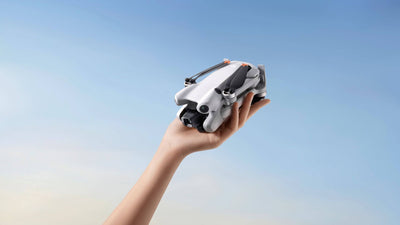
The DJI Neo range is a popular starting point thanks to its protected propellers, stable hover and simple controls, making it safe to fly around children indoors and out. For a coding focused option, the Ryze Tello remains a firm favourite in classrooms and at home. Picking up a couple of spare batteries from the start means a flat pack never cuts a games session short.
FAQs
What age can a child fly a drone in the UK?
There is no minimum age in UK law, but children under 12 must be supervised by someone aged 16 or over when flying outdoors. Young people aged 13 to 17 can take the free Flyer ID test and fly unsupervised once they pass.
Are drones safe for kids?
Yes, when matched to the child's age and flown with supervision. Choose a model with enclosed propeller guards and beginner modes, launch from a flat surface, and keep clear of people, roads and power lines.
Do kids need a Flyer ID to fly a drone?
A Flyer ID is needed for most drones flown outdoors, and 13 to 17 year olds can register for one themselves. Drones under 100 grams and any drone flown purely indoors are exempt, so very light toys are a simple way to start.
What is the best drone for a child to start with?
A good first drone is lightweight, has propeller guards and offers a beginner mode with altitude hold. Models such as the DJI Neo or the programmable Ryze Tello are popular choices for younger pilots.
Can you play drone games indoors?
Yes, plenty of drone games work indoors as long as you have a clear, open space. Landing challenges, gentle obstacle courses and coding patterns are all well suited to flying inside, and indoor flights need no Flyer ID.
Final Thoughts
Drone games give children an active, screen light way to build real skills, from coordination and patience to coding and problem solving. A safe space, a little supervision and a robust beginner drone are all it takes to get started, and the games grow with your child as their flying improves.
Ready to get a young pilot airborne, explore beginner-friendly camera drones at the Coptrz official online store.